
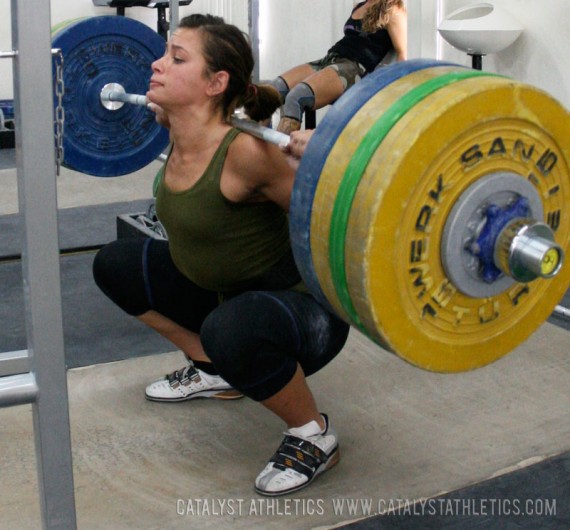
I found this article by Greg Everett from Catalyst Athletics about squatting stance quite interesting, so I thought I would share it with you…
With the Olympic lifts, it’s easy to wander a little too far down the rabbit hole and find yourself lost amid overwhelming detail. There are times when such detail is necessary and helpful, but at other times, the best course of action is to simplify. Sometimes this just means reassessing a problem with a perspective guided by simplicity—that is, returning to the basics to fix the complex.
If you’re struggling to figure out why your snatch and clean receiving positions are unreliable, uncomfortable or otherwise not working well for you, take a look at your back squat and front squat stance and movement. Surprisingly often, athletes use different squat stances for the back squat, front squat and overhead squat—this is usually in response to the different demands on position and flexibility and what they presently can and can’t get away with. Something I try to emphasize is that each athlete should have one squat stance—this stance should be the same in the back squat, front squat, overhead squat, snatch, clean, power snatch, power clean and power jerk. It doesn’t get much simpler than that, yet this creates problems for athletes who have been working around various in-flexibilities or habits rather than addressing the source of the issues.
The goal of squatting in the context of the Olympic lifts is straightforward: to achieve maximal depth with the most upright posture possible (it should go without saying that we also need proper spinal extension and balance across the foot). This is what allows the athlete to create the structure necessary to best support weights overhead in the snatch or on the shoulders in the clean.
Every repetition of every exercise you perform is practice—if you want to improve your performance, you better take those repetitions seriously and execute them in a manner that supports your objectives. Applying this to weightlifting and the squat stance, every time you squat, you’re practicing and reinforcing a particular position and movement pattern, along with reinforcing patterns of flexibility. If this position and movement is different than what you need in the snatch and clean, you’re complicating what should be a simple element of these lifts and creating difficulty where it doesn’t need to exist.
This problem is often at the root of large disparities between an athlete’s squat and Olympic lift numbers. When you compare the similar elements of the lifts (i.e. the squat), you see totally different movements and positions. A common example is a lifter who squats with the toes and knees more forward, yet in order to achieve the postures necessary for the snatch and clean to be successful, needs to squat with the toes and knees spread more. There are two potential problems created now: Either the athlete is continually receiving snatches and cleans with this squat stance, which prevents them from executing the lifts successfully, or they’re weak and imbalanced when receiving snatches and cleans with the proper stance because they simply haven’t trained a high enough volume of quality repetition with it. In both cases, a strong athlete misses lifts that should be easy makes, or worse, risks injury for no good reason.
A related problem is the lifter who likes to cheat depth when squatting rather than sitting all the way in. This athlete will often be able to stop short similarly in the snatch and clean up to a certain point, and then beyond this threshold, suddenly falls apart, either getting buried in the bottom of the clean or unable to stabilize a snatch overhead. This is such a silly reason to be missing lifts—watching it happen is one of the things that irritates me most as a coach, especially when that lifter proceeds to whine about missing yet ignores repeated instructions to squat right.
Ultimately, I see this problem as a symptom of being lazy and impatient in a sense. It happens when athletes are more interested in hurrying through their workouts than in ensuring the quality of every rep taken, or in inflating strength numbers by altering the movement. Neither of these is a behavior of an athlete motivated to achieve the best possible results—decide what kind of athlete you want to be and train accordingly.
How do you fix all this? Very simple: Find your correct squat stance and use it for every squat you do, and when you squat, snatch and clean, always—I mean always—sit all the way in. If you’re trying to recover from a long period of bad habits, sit in the bottom of all snatches and overhead squats for 2-3 seconds before standing—and when I say the bottom, I meant the bottom. Pause back squats are a great exercise as well for strengthening the deepest part of the squat. It’s not that fun, but neither is missing lifts you should be making.
~ by Greg Everett
Next time you are squatting, like today, take note of how you squat 😉 Is it different from your back squat yesterday? Is it different from your air squat? If you are unsure on how to make all your squat stances the same, please ask your coach for help.
IMPORTANT ADMIN ANNOUNCEMENT: There is a glitch in our system that debits the your account/credit card for your membership. When a payment goes through, it has been sending an email to you saying that we had a problem with your payment. We don’t have a problem with your account at this time unless Sandy sends you a personalized email. This glitch will not be fixed for a week, so if your membership is coming due, you will get this email. Sorry for the any inconvenience.
Christmas Party: You are still welcome to purchase a Christmas party ticket. We have unlimited tickets available! We now have a good estimate if how many will be attending the party. We have ordered heaters, so it will be a dress up party! Wear your fancy party dress or new tie 😉
Today’s Workout:
Buy In – Coach led shoulder warmup followed by Skin the Cat technique
WOD – “Nancy”
5 rounds for time of:
400m run
15 overhead squats (65/95)
Compare to May 3, 2012
Zone 3: scale overhead squats to 45/65
Zone 2: scale to 35/45
Zone 1: scale as needed (including # of rounds)
Cash Out – Foam roll your quads, hamstrings, calves and IT band
http://www.snorgtees.com/t-shirts/short-barbarian…
All Lucas fan's heading to the games to cheer him on (the open and regionals are a formality I'm sure), should all invest in the above Lucas style headgear… how could would that cheering section look!
ahh!!! that should be "how COOL would that cheering section look!" – fail
Love it!
I read this paragraph completely on the topic of the difference of hottest and earlier technologies,
it’s remarkable article.
Hi there everyone, it’s my first pay a visit at this site, and piece of writing is actually fruitful for me, keep up posting such articles.