
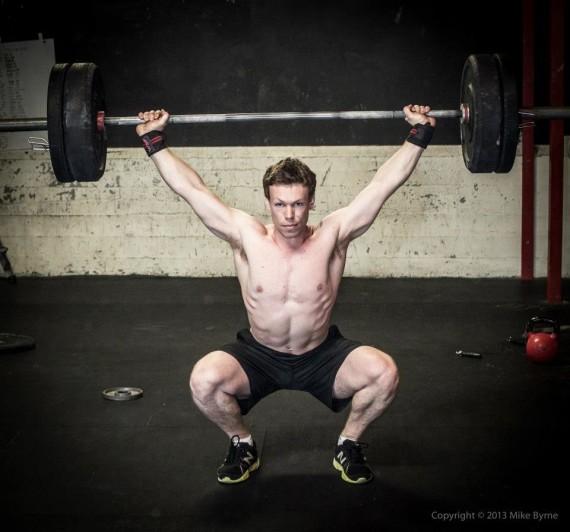
Image courtesy of Clock Tower Images Inc., photo by Mike Byrne
Last week to improve on your overhead squat for this month. Have you improved?
~ By Greg Glassman (founder of CrossFit)
The overhead squat is the ultimate core exercise, the heart of the snatch, and peerless in developing effective athletic movement. This functional gem trains for efficient transfer of energy from large to small body parts – the essence of sport movement. For this reason it is an indispensable tool for developing speed and power. The overhead squat also demands and develops functional flexibility, and similarly develops the squat by amplifying and cruelly punishing faults in squat posture, movement, and stability.
The overhead squat is to midline control, stability, and balance what the clean and snatch are to power – unsurpassed.
Ironically, the overhead squat is exceedingly simple yet universally nettlesome for beginners. There are three common obstacles to learning the overhead squat. The first is the scarcity of skilled instruction – outside of the Olympic lifting community most instruction on the overhead squat is laughably horribly, wrong – dead wrong.
The second is a weak squat – you need to have a rock-solid squat to learn the overhead squat. We strongly recommend you review the December 2002 issue of the CrossFit Journal on squatting before attempting the overhead squat; you could save yourself a lot of time in the long run. The third obstacle is starting with too much weight – you haven’t a snowball’s chance in hell of learning the overhead squat with a bar. You’ll need to use a length of dowel or plastic PVC pipe; use anything over five pounds to learn this move and your overhead squat will be stillborn.
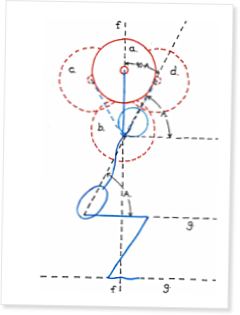
A: The torso’s angle of inclination above horizontal. As a squat matures this angle increases. The squat becomes more upright as the athlete’s strength and neural “connectedness” to the posterior chain increase. Lower angles of inclination are created in an attempt to cantilever away from a weak posterior chain and onto the quadriceps. While technically correct, the lower angle is mechanically disadvantaged.
90-A: This is the angle of rotation of the arms, at the shoulders, past overhead. The lower A is, the greater the rotation, 90-A, required of the shoulders to keep the bar in the frontal plane. The larger 90-A is, the wider the grip required to allow the shoulders to rotate to keep the bar in the frontal plane. Ultimately the connectedness/strength of the posterior chain will determine the width of the grip, elevation of the squat, and degree of rotation of the shoulders. Maturity and quality of the squat is a determinant of all of the mechanics of the overhead squat.
g: These lines mark horizontal
f: This line defines the frontal plane. It divides the athlete front half from back half. In the squat (as with most weightlifting movements) the athlete endeavors to keep the load in this plane. If a load deviates substantially from this plane the athlete has to bring the load back, which in turn pulls the athlete off balance.
b: This is roughly the position for a back or front squat.
a: This is the position for the overhead squat. With perfect stability, movement, and alignment this position does not increase the moment about the hip or back. The difference in an athlete’s strength when squatting here, overhead, as opposed to position b, the back or front squat, is a perfect measure of instability in the torso, legs, or shoulders, and improper line of action in the shoulders, hips, or legs, and weak or flawed posture in the squat.
c: This position has the load behind the frontal plane. It can actually decrease the moment on the hip and back. As long as balance is maintained the position is strong.
d: This is a fatal flaw in the overhead squat. Even slight movement in this direction greatly increases the moment in the hip and back. Moving in this direction with even a small load can collapse the squat like a house of cards.
- 8:00am – 9:30pm
- 10:30am – 12:15pm
- 1:15pm – 4:30pm